


 Articles


HIROSHIMA DAY
ON 80TH ANNIVERSARY OF HIROSHIMA, RISK OF NUCLEAR USE AS GREAT AS EVER, AS US, RUSSIA, EXCHANGE NUCLEAR THREATS
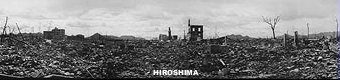
80 years ago today, at 8.15 in the morning, 6th Aug 1945, a nuclear weapon was used in war for the first time, flattening the city of Hiroshima and turning it into a fire storm with up to 200,000 casualties by some estimates. On Aug 9th 1945, a slightly larger weapon, of a different technology was used to flatten the city of Nagasaki, but because the Nagasaki bomb did not hit the city centre and because the topography had a shielding effect, Nagasaki had somewhat fewer casualties than did Hiroshima. Nontheless damage in both cites was regarded as horrific.
The Hiroshima weapon was a 15Kt uranium-based 'gun' device. The Nagasaki weapon was a 20Kt plutonium based implosion device, now a standard design. Present day weapons dwarf these ones, which would now be regarded as 'tactical' weapons, ranging from 200Kt to a megaton. The largest warhead ever detonated was the Russian 'Tsar Bomba' (King of bombs) of 1963, at nearly 60megatons.
What is deeply alarming is that, on the 80th anniversary of an event that should be mourned not celebrated, and that should never happen again, nuclear threats are being exchanged even more openly than they were ever exchanged during the Cold War.
The latest round between President Trump and former President of Russia Dmitry Medvedev, has Medvedev suggesting Trump 'watch his language' when he talks about nuclear weapons and nuclear deployments – days after Trump has said essentially the same thing about Medvedev.
It would seem that 'watching your language' when it comes to nukes and especially watching body language (deployment of nuclear forces, nuclear posture) might be good advice all around. What is needed above all is a reduction in tensions, and restraint from using nuclear weapons as a tool of blackmail to get what one wants. The US has done plenty of that in the past, notably under Nixon. Now it seems to be Russia's turn. Whomever does it puts the whole world into danger.
The widespread use of nuclear weapons would incinerate up to half of all humans in large cities in roughly 90 minutes, and would create a 'nuclear winter' in which those who did not get vaporized in those 90 mins would mostly starve to death in semi-darkness bought about by the smoke from burning cities that would linger for decades.
While the primary threats to civilisation and human survival come from the US and Russian nuclear arsenals, China, India and Pakistan have also enough megatonnage to induce a 'nuclear winter lite'. Israel and the DPRK have enough to do significant damage. Thus far, Iran has no warheads.(yet).
Australia and NZ are considered the best places to flee to if buttons get pushed. However, Pine Gap, NW Cape, the B-52 base near Darwin, and naval bases in Perth and Sydney are likely targets. If Wollongong/Kembla hosts nuclear subs it will be a target.
There is no sign of any contingency planning in this country for possible nuclear war. In the 1980s there was a lot of such planning, yet there is little sign even of '80s emergency plans being dusted off. Of course, such plans would NOT ensure survival for most people – those of us in Sydney would mostly just perish if a Russian of Chinese megaton warhead exploded over the CBD – but still it might allow a few more to eke out a miserable survival afterwards in the semi-darkness of nuclear winter.
Australia seems to think it is a mere passive spectator in all of this. It is not. We are deeply implicated in US nuclear targeting via Pine Gap and NW Cape, but we also could play a constructive role. Yet we are failing to rise to the challenge.
Australian diplomacy could make a real difference in promoting nuclear risk reduction measures which though they are NOT the ultimate solution to nuclear weapons – only abolition is that – might nontheless make the difference between having a nuclear exchange and not having one. These are measures like No First Use, de-alerting, and a range of seemingly technical 'fixes' that go far to diminish the likelihood of an inadvertent apocalypse.
Labor policy is committed to Australia signing and ratifying the Treaty for the Prohibition of Nuclear Weapons. The measure was put on ALP policy by no less than Anthony Albanese, the Prime Minister. He should have the courage of his convictions and follow through. There have been moves in Labor branches to urge the Government to do just that.
Otherwise we are just like a Kangaroo in a freeway, blinking stupidly into the headlights of an approaching nuclear juggernaught.
Your attention is drawn to the event below.
(institutional affiliations for identification purposes only)
John Hallam
Nuclear Disarmament Campaigner
People for Nuclear Disarmament
Human Survival Project
Co-Convenor, Abolition 2000 Nuclear Risk Reduction Working Group
Member, No First Use Global Steering committee
This e-mail address is being protected from spambots. You need JavaScript enabled to view it
This e-mail address is being protected from spambots. You need JavaScript enabled to view it
This e-mail address is being protected from spambots. You need JavaScript enabled to view it
0411-854-612

